A basic blackjack chart shows how to play your hand based on the dealer’s visible card. It includes strategies like hitting, standing, doubling down, splitting cards, and giving up the game. Recommended strategy is a move that gives you the best result on average in terms of finance under certain rules of the game. Sometimes it means growing your profit, and sometimes — reducing your loss.
It is nice to have a strategy before the hand gets complicated. Hands like 16 versus 10 of the dealer seem to be terrible whatever decision you choose to make, while ace and 7 may seem good enough for any situation. Basic strategy gives you consistency in those decisions. But first you should learn the rules, which are applied in the chart.
How to Interpret a Basic Strategy Table
In the classic table, the value of your hand is shown on the left-hand side while the value of the up card of the dealer is indicated on the top. Find both and find out the recommendation in the intersection of the respective row and column. Number 10 refers to the jack, queen and king because all of them have the value of ten points. Symbol A denotes an ace.
Symbols in tables vary; however, H is often used for hit, S for stand, D for double down, P or SP for split pairs, and R for surrender. The symbol Dh means double down if available and hit otherwise. Symbol Ds means double down if available and stand otherwise. Always check what symbols mean in the particular table and what colours refer to different actions.
It is important to know the order of the decisions as well. Check whether you need to surrender, split the pairs, double down and hit or stand. If you do not follow this order, you can treat a pair of 8s as an ordinary hard 16 and miss the recommended split.
Check the Table Rules First
The table below is made with the assumption of the typical rules of Blackjack. Namely, it is based on a game with 4–8 decks, the dealer standing on all 17s, including soft 17, and doubling allowed on any first two cards, including after splitting. In addition, it assumes that the dealer checks for the blackjack on the ace or ten-value up card. Late surrender, if available, is considered below. These assumptions will be valid in all examples of this article.
A chart for the given rules can be not used for playing one-deck games, games when the dealer hits soft 17, and games where there is no hole card. Any change in the rules can change your strategy. For instance, the hard 11 against the ace is a hit in the game played according to the given rules; however, it is a double in the multi-deck game with the dealer hitting soft 17.
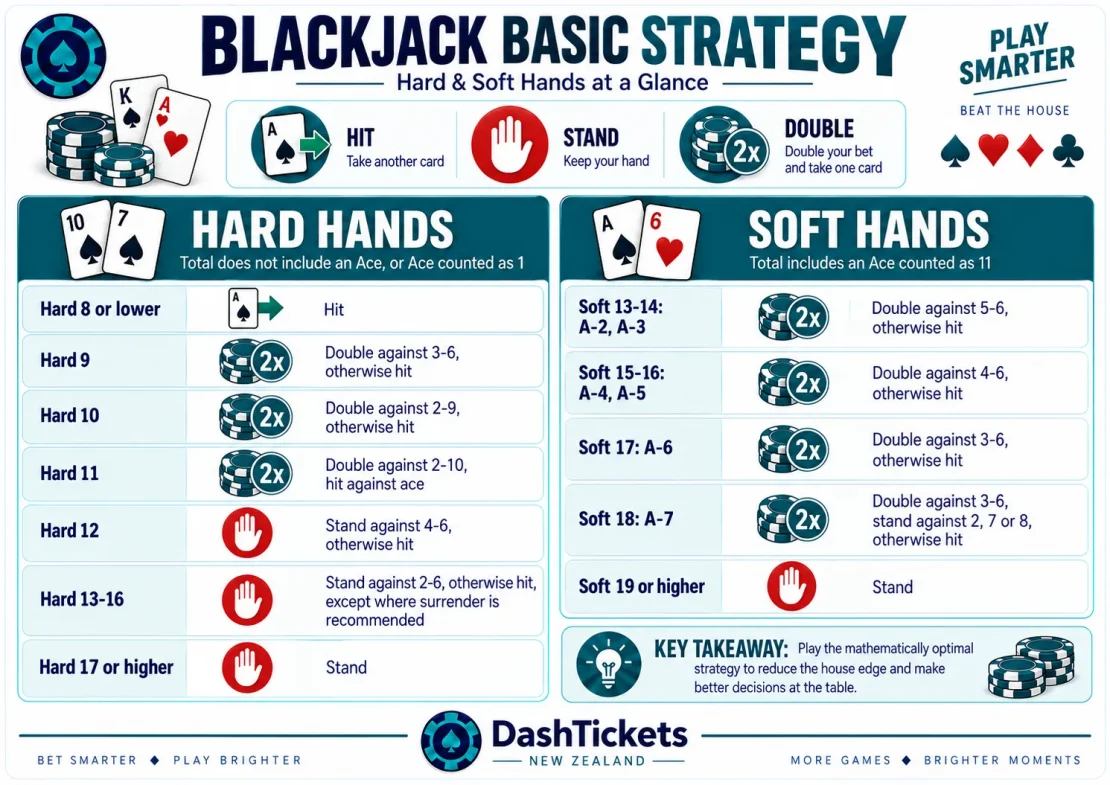
A Condensed Guide to Playing Blackjack
A soft hand is one where the ace is counted as 11; A-6 is thus soft 17. A hard hand is one without an ace counted as 11; A-6-10 and 10-7 are both hard 17s. Having an ace does not mean you have a soft hand. Look up surrender and pair splitting first before using this guide to total.
These actions are based on basic blackjack strategy for four to eight decks of cards. If doubling is not possible, then hit in case of the aforementioned hard hands, and the soft 13-17. If soft 18 against 3-6, stand. This rule is important even after drawing a new card and doubling is no longer possible.
When to Surrender or Split
In this case, surrender the first hard 15 when facing the dealer’s 10, or hard 16 against a 9, 10 or ace upcard. An exception to the hard 16 case would be to split a pair of eights. The end of surrender results in returning half of the original stake, if the dealer’s hand did not turn out to be blackjack.
In the absence of surrender, use the appropriate strategy to play according to hit or stand. With regards to the pair, split aces and eights against any upcard. Tens are to be kept together, while a pair of 5s should be played as hard 10 rather than being split. In the case of other pairs, where doubling after splitting is allowed: split 2s, 3s and 7s against 2–7 upcard; 4s against 5–6 upcard; 6s against 2–6 upcard; and 9s against 2–6 upcard or 8–9 upcard. Where it is not necessary to split, use the hand value in the basic blackjack chart.
Splitting 9s Against Dealer’s 7 – an Example to Explain Why to Pay Attention to Pairs
In this case, even though splitting against several upcards is recommended, you still stand with 18 against 7. Splitting 9s also costs one another unit of the stake, which adds to the amount of money involved in the hand. Recommendations apply to the average outcome of the action, not the fact of the winning of each new hand.
Putting the Chart to Work
Let us take an example of 10-2 with the dealer showing 3. In this case, you will have hard 12, which according to the chart should be hit despite having a relatively low dealer’s card. Now, if we change it to 4 upcard, you should stand. It is such small difference which makes “always stand against weak dealer’s card” too vague rule.
Now consider a player holding A-7 against the dealer’s 9. Since it is soft 18, the chart suggests hitting. If the next card is a 10, then the ace will turn into 1 and the player will have hard 18, which he will stand on. The player has not busted and the next move will come from the hard-total line.
With 5-6 against the dealer’s 6, according to the chart, the move is to double down. In that case, a player’s NZ$10 initial bet turns into NZ$20 and he gets one more card to make a hand. In case doubling down is not available, hit. The explanation of when to double down in blackjack contains an explanation of the commitment and its alternatives.
What Basic Strategy Can and Cannot Do
Basic strategy analyzes the expected financial outcomes of the possible actions. It does not guarantee the player’s success on the next hand or even promises profitability in a complicated situation. Thus, splitting 8s against a strong dealer card can still end in a loss. The idea is that one of the available actions works better statistically under the same conditions.
The house edge also depends on the particular game. For instance, a natural blackjack, which pays 3:2 provides NZ$15 in profit on a NZ$10 bet, while 6:5 gives only NZ$12. No matter how well the decisions are made, the missing money is never to be recovered. Our article on the house edge of blackjack tells how it is influenced by the table rules.
A basic strategy for blackjack does not care what cards have been removed from the shoe yet. Card counting is another technique that utilizes additional knowledge and makes different decisions. Neither a winning streak nor losses should force the player to ignore the chart and boost his bet size. There is no way to know from them if the next hand will be favorable.
Chart Learning Procedure
Start from setting up consistent rules while practicing. Shuffle your own pack of cards and deal two cards to yourself and one upcard of the dealer. Make a choice and write down what category corresponds to your choice according to the chart. Note down those hands that are wrong and analyze them. Some mistakes will be easier to fix rather than memorize everything.
I would like to draw your attention to the following hand: hard 12, soft 18 and pairs because a simple glance at the hand may mislead you and you won’t pick a correct category. Learn also how to act in case doubling or surrendering are not possible. The free gambling game allows you to perform all these operations without any financial losses. But when you start playing for real, don’t forget to allocate a budget for playing.
Sophia Novakivska has already been spending 12 years on everything related to gambling writing. Slot and casino reviews, comparisons, top options for different audiences, news, how-tos and gambling history - she knows the area and proved it with her publications on Better Collective, AskGamblers and Gambling.com. For four years, Sophia is into NZ iGaming niche where she analyzes the online casino bonuses, live games, new slot releases, and sport news. Sophia’s credentials: GLI University’s iGaming testing & compliance course (2020) and UKGC-approved Responsible Gambling certification (2022).
If you want to get ahead in blackjack, you must understand blackjack card values. There are lots of casino games that rely just on luck; blackjack is a game that gives players decisions to make based on the cards they hold. Whether you play in a land-based establishment or through an online site, knowing how […]
By far the most popular roulette wheel to play is the European roulette wheel. This is due to its simple layout and the fact that there is only one zero on the wheel. The differences between American roulette and European roulette are the odds. Playing on a European roulette wheel means you get better odds […]
The big question for gamblers is what the house edge is in blackjack; the answer depends on the rules of the game, as well as how you play. When bettors use a solid strategy as well as common sense, blackjack is one of the games with the smallest house edge. In certain situations, the house […]

 Sophia Novakivska